Statutory Compliance in HR & Payroll in India: Complete Guide
CHROs and CFOs managing compliance across several states at once are tracking different regulatory regimes, not one. Here is the architecture that handles all without manual intervention.

Table of contents
One unstitched HR platform to manage your entire workforce, from hire to rehire.
Talent Management solutions built for growing and exceptional people
Built-in compliance tools that update with changing regulations
Automated payroll, attendance, and leave management
Insights that help HR leaders make faster, better decisions

Key Takeaways
- Statutory compliance in HR: It is the mandatory adherence to central and state labour laws governing wages, benefits, workplace safety, data protection, and employee rights in India.
- Who benefits most: CHROs, CFOs, compliance officers, and Boards of enterprises in BFSI, Manufacturing, Pharma, Retail, and IT and ITes, particularly those with multi-location, high-headcount operations.
- Critical acts: 10 core Indian laws, including EPF Act 1952, ESI Act 1948, Minimum Wages Act 1948, PoSH Act 2013, and DPDP Act 2023, form the foundation of HR statutory compliance.
- Automation imperative: HRMS tools with automated payroll, real-time audit trails, and compliance dashboards reduce manual errors and cut penalty risk by enabling proactive, zero-touch compliance management.
- ZingHR's value: ZingHR's AI-powered Hire-to-ReHire platform, powered by ZingZeroTAP and Ghrowth.ai, its agentic intelligence engine, unifies compliance, analytics, and execution across enterprise-scale operations on one codebase and one database with 35+ modules. Book a demo to see real-time compliance dashboards in action.
- Priority this year: With the DPDP Act 2023 now fully enforceable, enterprises must prioritise data consent workflows, secure employee data processing, and real-time compliance reporting.
HR statutory compliance is at the centre of enterprise governance for large companies in BFSI, manufacturing, pharma, retail, and IT/ITeS. India’s regulatory structure cuts across central laws, state rules, and industry-specific obligations, which makes manual compliance tracking risky at scale.
According to the Ministry of Labour and Employment, companies failing to meet statutory requirements may face fines ranging from ₹1,000 to ₹10 lakh per violation, along with criminal liability and business license cancellations.
The pressure is higher in 2026. The Digital Personal Data Protection Act, 2023, adds stricter obligations around employee data consent, security, processing, and record handling. Enterprises managing thousands of employees across multiple locations cannot rely on spreadsheets, scattered trackers, and manual reminders without creating audit gaps.
Boards need compliance systems capable of showing what was filed, when it was filed, who approved it, and where risk still exists.
This guide is built for CHROs, CFOs, compliance officers, and senior leaders managing HR statutory compliance at enterprise scale. It covers the core types of HR compliance, 10 critical Indian statutory acts, employee benefits and workplace-safety checklists, practical compliance controls, and the role of technology, including ZingHR’s AI-powered Hire-to-Rehire platform.
10 Critical Acts Under Statutory Compliance in HR: At a Glance
The reference table below summarises the 10 core acts defining statutory compliance obligations for HR and payroll teams in India. Each act is mapped to its applicability threshold, key obligation, and non-compliance risk. Use it as a quick reference when scoping a compliance audit or designing an enterprise HR governance framework.
10 critical acts under Indian statutory HR compliance with applicability, key obligation, and penalty.
The objective is to provide CHROs, CFOs, and compliance teams with a balanced, actionable resource for managing statutory compliance in HR across industries and geographies.
What Is Statutory Compliance in HR?
Statutory compliance in HR means following the workforce laws, rules, regulations, and internal policies set by India’s central and state governments. It covers payroll compliance, including salary calculation, provident fund contributions, tax deductions, ESI deposits, and other mandated deductions. When managed poorly, these obligations create fines, disrupted operations, employee disputes, and reputational damage.
ZingHR’s enterprise HCM architecture helps enforce these requirements across the employee lifecycle instead of leaving them scattered across payroll files, HR trackers, and department-level checklists.
Enterprise compliance cannot stop at payroll runs. It must cover hiring, onboarding, compensation, benefits, workplace safety, grievance redressal, employee data protection, and separation. Every organization operating in India must follow both central laws and state-specific acts.
Leaders building stronger HR compliance in India need to understand the main compliance categories first, then put systems in place to manage each obligation consistently across locations, entities, and employee groups.
Types of HR Compliance
HR compliance breaks into six distinct categories, each with different sources, mandates, and enforcement mechanisms. Understanding the distinctions allows compliance teams to allocate resources where the regulatory risk concentrates.
You can also use Ghrowth.ai's role-specific command centres to surface compliance posture by category for the boardroom.
1. Statutory Compliance
The category refers to adherence to laws enacted by the central, state, and local governments, such as labour laws, tax regulations, and wage laws, and makes organisations meet the minimum legal standards required for employee treatment and business operations.
These laws provide benefits like a provident fund, gratuity, minimum wages, and safe working conditions.
2. Regulatory Compliance
Regulatory compliance involves following the rules and guidelines set by industry-specific regulatory bodies. In India, these include the Securities and Exchange Board of India (SEBI), the Reserve Bank of India (RBI), the Food Safety and Standards Authority of India (FSSAI), and the Telecom Regulatory Authority of India (TRAI). The category includes maintaining licences, submitting mandatory reports, and aligning with sectoral standards.
3. Contractual Compliance
The category makes the organisation meet the obligations outlined in contracts with employees, vendors, or clients, helping avoid legal disputes and maintain business credibility. For enterprises with large contract workforces, common in Manufacturing, IT and ITes, the category is a high-risk area.
4. Union Law Compliance
Union law compliance relates to managing relationships with labour unions, including collective bargaining agreements, grievance handling, and fair labour practices, and keeps interaction between employers respectful and lawful and unionised employees, particularly critical in Manufacturing, Mining, and public sector enterprises.
5. Internal Compliance
Internal compliance focuses on adherence to company-specific internal policies, codes of conduct, and ethical standards, reinforcing a culture of accountability and consistency within the organisation. Enterprises with unified HCM platforms typically centralise policy management to lock in uniform enforcement across locations.
6. Workplace Safety and Health Compliance
The category requires employers to provide a safe and healthy working environment, following laws like the PoSH Act 2013, the Factories Act 1948, and other national safety regulations. In regulated industries such as Pharma and Manufacturing, the category extends to hazardous material handling, occupational health monitoring, and incident reporting protocols.
Statutory vs. Regulatory vs. Non-Statutory Compliance: Key Differences
Understanding the distinction between statutory, regulatory, and non-statutory compliance helps HR teams allocate resources effectively. The summary table below clarifies the source, mandate, examples, penalties, and enforcement venues for each.
Comparison of statutory, regulatory, and non-statutory compliance across source, mandate, examples, penalty, and enforcement venue.
Acts Covered Under Statutory Compliance in HR
The following 10 acts form the legal backbone of statutory compliance for HR and payroll teams in India. Each carries specific applicability thresholds, employee protections, and employer obligations.
The depth of detail required varies by sector, but unified compliance engines handle the variation natively rather than through patchwork add-ons.
1. The Shops and Establishments Act (State-Specific)
The Shops and Establishments Act regulates working conditions, working hours, opening and closing times, payment of wages, leave, holidays, and other service conditions for employees in shops, commercial establishments, hotels, restaurants, and similar entities.
Per the act, a 'shop' is any premise (online or offline) where goods are sold to customers or services are rendered.
An 'establishment' is a factory-like premise where goods are manufactured and prepared for sale. The act is state-specific, meaning it may have different clauses for shops and establishments in different states. For enterprises operating across multiple states, navigating state-specific variations is one of the most operationally complex compliance challenges, making automated tracking essential.
2. The Factories (Amendment) Act, 1987
The Factories Act focuses on ensuring the health, safety, and welfare of workers employed in factories, setting standards for working hours (48-hour weekly limit), cleanliness, ventilation, lighting, and accident prevention.
The act applies to any factory using electricity employing 10 or more workers during any part of the manufacturing process, or 20 or more workers without power. Factory owners are required to maintain a physically safe workplace, with provisions for overtime at double the ordinary rate.
It also details penalties for non-compliance, including fines up to ₹2 lakh and potential facility closure orders.
3. The Payment of Gratuity Act, 1972
The Payment of Gratuity Act mandates the payment of gratuity, a lump sum amount, to employees by their employers as a token of gratitude for services rendered. The act covers employees working in factories, shops, offices, establishments, railways, oilfields, and mines.
Gratuity is payable upon completion of at least five years of continuous service in the same company, and is disbursed post-retirement, resignation, death, or disablement. The current maximum limit is ₹20 lakhs.
It applies to both full-time and contractual workers in organisations with 10 or more employees.
4. The Employees' Provident Funds & Miscellaneous Provisions Act, 1952
The EPF Act requires companies with 20 or more employees to establish a mandatory provident fund, pension fund, and deposit-linked insurance fund. Employer and employee each contribute 12% of the employee's salary (basic + dearness allowance) to these funds.
The act details three schemes:
- Employees' Provident Fund Scheme (EPF)
- Employees' Pension Scheme (EPS)
- Employees' Deposit-linked Insurance Scheme (EDLI).
All funds earn interest as notified by the Central Government.
The Central Board of Trustees (CBT) and the Employees' Provident Fund Organisation (EPFO) administer the legislation. Contributions must be deposited by the 15th of the following month.
5. The Employees' State Insurance Act, 1948
The ESI Act was the first major social security legislation for Indian workers. It provides medical, sickness, maternity, disability, and dependent benefits to employees and their families in certain industries and establishments, funded by contributions from both employers (3.25%) and employees (0.75%).
The act involves organisations with 10 or more employees, covering those earning up to ₹21,000 per month (₹25,000 for persons with disabilities).
The primary objective is to shield employees and their families from financial burdens caused by health-related problems and workplace injuries resulting in loss of wages or earning capacity.
6. The Minimum Wages Act, 1948
The Minimum Wages Act authorises the central and state governments to fix and revise minimum wages for different kinds of employment, making sure workers receive a basic standard of living and preventing exploitation.
The act applies to both skilled and unskilled labourers. The primary goal is to protect workers in vulnerable sectors with low bargaining power from being underpaid. Minimum wage rates are determined based on cost-of-living indices and vary by state, industry, and skill level.
Non-compliance can result in fines up to ₹50,000 and imprisonment up to 6 months.
7. The Payment of Bonus Act, 1965
The Payment of Bonus Act governs the payment of a bonus to employees in establishments with 20 or more workers, based on profits or productivity. It mandates a minimum bonus of 8.33% and caps the maximum at 20% of an employee's salary or wage. Eligible employees are those earning up to ₹21,000 per month. The bonus formula works as follows.
The act is essential for ensuring fair compensation and fostering positive employer-employee relations.
8. The Payment of Wages Act, 1936
The Payment of Wages Act regulates the timely payment of wages and prevents unauthorised deductions. Employers must pay wages by the 7th of the following month (for establishments with fewer than 1,000 workers) or by the 10th (for larger establishments).
It explicitly defines permissible deductions, preventing arbitrary cuts. It also provides a mechanism for employees to file claims and seek resolution in cases of delayed payment or unauthorised deductions. Violations attract fines and potential imprisonment for repeated offences.
9. The Maternity Benefit Act, 1961
The Maternity Benefit Act provides maternity leave and other benefits to women employees during pregnancy and childbirth, mandating 26 weeks of paid leave for the first two children and 12 weeks for subsequent children. Six weeks of leave is provided in case of miscarriage or medical termination.
The act requires full salary payment during the leave period, mandates a medical bonus, and provides protection from dismissal during pregnancy and maternity leave. Women adopting a child under three months of age are entitled to 12 weeks of paid leave. It primarily aims to promote gender equality in the Indian workplace.
10. The Sexual Harassment of Women at Workplace Act, 2013 (PoSH)
The PoSH Act mandates the prevention of sexual harassment against women at the workplace and the creation of a safe working environment. It requires employers with 10 or more employees to establish Internal Complaints Committees (ICCs) for investigating complaints and finding resolutions.
Sexual harassment under the act includes unwelcome conduct of a sexual nature, such as physical advances, requests for sexual favours, suggestive remarks, and other unwelcome behaviour. Employers must formulate and widely publicise an anti-sexual harassment policy and create awareness through regular training.
Non-compliance can attract fines up to ₹50,000, with licence cancellation on repeat offences.
Statutory Compliance Checklist for HR and Employees
The following checklist covers adherence to the legal requirements of statutory compliance in HR for 2026. Although detailed supervision is required to thoroughly comply with statutory and other regulations, the checklist helps HR teams maintain accuracy and save time, especially critical for enterprises managing compliance across multiple states and locations.
Pair the checklist with ZingZeroTAP's zero-touch payroll engine for automated execution.
Employee Benefits Checklist
1. Employees' Provident Fund (EPF):
- Applies to organisations with 20 or more employees.
- Covers employees earning up to ₹15,000 per month, although those earning more can also apply.
- Both the employer and the employee contribute 12% of the employee's salary (basic + dearness allowance) to the fund.
- The due date is the 15th of the following month.
- Must be deposited with the Employees' Provident Fund Organisation (EPFO).
2. Employees' State Insurance (ESI):
- Applies to organisations with 10 or more employees.
- Covers employees earning up to ₹21,000 per month (₹25,000 for persons with disabilities).
- The employer's contribution is 3.25% of the employee's salary, while the employee contributes 0.75%.
- The due date is the 15th of the following month.
- Must be deposited with the Employees' State Insurance Corporation (ESIC).
3. Gratuity:
- Applies to organisations with 10 or more employees.
- Covers employees who have completed at least five years of continuous service in the same company.
- Payable upon retirement, resignation, superannuation, death, or disablement.
- Maximum limit is ₹20 lakhs.
- Formula: (15 × Last drawn salary × Number of years of service) / 26.
4. Bonus:
- Applies to organisations with 20 or more employees.
- Covers employees earning up to ₹21,000 per month.
- Minimum bonus payable is 8.33% of the employee's salary. Maximum is 20%.
- Formula: If salary is less than ₹7,000, Bonus = (Basic salary + DA) × Bonus percentage. If salary exceeds ₹7,000, Bonus = ₹7,000 × Bonus percentage.
5. TDS (Tax Deduction at Source):
- Employers are responsible for deducting income tax at source from employees' salaries based on applicable tax slabs.
- Must provide Form 16 (TDS certificate) to employees annually by specific deadlines.
- Requires timely deposit of deducted tax with the Income Tax Department and filing of TDS returns.
Workplace Safety Checklist
6. The Factories Act, 1948:
- Applies to factories employing 10 or more workers with power, or 20 or more without power.
- Mandates provisions for workers' health (cleanliness, ventilation, drinking water), safety (machinery guarding, fire safety), and welfare (crèches, canteens).
- Regulates working hours (48-hour weekly limit, double overtime rate), leave, and employment of women and young citizens.
- Requires registration and approval of factories with the Chief Inspector of Factories.
7. The Contract Labour (Regulation and Abolition) Act, 1970:
- Applies to organisations or contractors employing 20 or more contract labourers.
- Mandates registration of establishments and licensing of contractors.
- Requires employers to adequately provide for worker welfare, wages, and social security.
Employee Relations Checklist
8. Maternity Benefit Act, 1961:
- Applies to organisations employing 10 or more persons.
- Provides 26 weeks of paid maternity leave for the first two children and 12 weeks for others.
- 6 weeks of leave in case of miscarriage or medical termination of pregnancy.
- Full salary must be paid during the leave period.
- Women adopting a child under three months of age are entitled to 12 weeks of paid leave.
- Mandates a medical bonus and protection against dismissal during pregnancy and maternity leave.
9. Sexual Harassment of Women at Workplace (Prevention, Prohibition, and Redressal) Act, 2013 (PoSH Act):
- Mandates every employer with 10 or more employees to constitute an Internal Complaints Committee (ICC).
- Requires employers to formulate and widely publicise an anti-sexual harassment policy.
- Provides a mechanism for redressal of complaints, including inquiry and recommendations.
10. Industrial Employment (Standing Orders) Act, 1946:
- Applies to industrial establishments employing 100 or more workmen (some states have lower thresholds).
- Requires employers to formally define and certify conditions of employment (working hours, holidays, termination, disciplinary action) as Standing Orders.
- Aims to minimise arbitrary actions by employers and provide certainty 11. regarding terms of employment.
11. Equal Remuneration Act, 1976:
- Prohibits discrimination in remuneration between men and women for the same work or work of a similar nature.
- Forbids discrimination on the grounds of gender in recruitment processes (unless gender-specific roles are legally permitted).
- Requires employers to maintain registers showing remuneration paid to employees.
Enterprise-Scale Compliance Challenges
For large enterprises, particularly those with 1,000+ employees across multiple Indian states, statutory compliance in HR presents challenges differing fundamentally from those faced by SMEs. The complexity compounds rather than simply adding up. Pair the operational reality with ZingHR's multi-entity compliance architecture to manage the layered demands.
1. Multi-Location and Multi-State Variations
India's Shops and Establishments Act varies by state. Minimum wage schedules differ by state and employment category. ESI applicability thresholds can shift with state notifications.
An enterprise with operations in Maharashtra, Karnataka, Tamil Nadu, and Delhi must simultaneously track and comply with four distinct regulatory regimes, each with its own filing deadlines, wage structures, and inspection protocols.
2. Industry-Specific Regulatory Layers
Enterprises in BFSI must comply with RBI and SEBI guidelines on top of labour laws. Pharma organisations face additional oversight from CDSCO and state drug authorities regarding employee safety and working conditions.
Manufacturing enterprises must work through the Factories Act alongside environmental and hazardous material regulations. These overlapping regulatory layers make manual compliance tracking unsustainable at scale.
3. High-Volume Payroll Complexity
Processing payroll for 10,000+ employees while ensuring accurate PF, ESI, TDS, bonus, and gratuity calculations, each governed by different thresholds and formulas, requires automated systems.
A single missed deadline or miscalculated deduction across a large workforce can trigger cascading penalties and audit exposure. Enterprises increasingly require unified HR systems consolidating compliance, payroll, and reporting.
4. Data Protection Under the DPDP Act 2023
With the DPDP Act 2023 now fully enforceable, enterprises processing large volumes of employee personal data (biometrics, health records, performance data, compensation details) must implement consent management frameworks, purpose limitation controls, and data breach response protocols.
The penalty ceiling of ₹250 crore per violation makes this a Board-level governance priority.
Why HR Compliance Is Crucial for Business Leaders
Statutory compliance is a critical pillar of enterprise governance, risk mitigation, and sustainable growth. For Boards and CXOs, ensuring strong compliance is essential to preserving reputation, enabling strategic agility, and opening business value.
The benefits compound when surfaced through Ghrowth.ai's role-specific command centres rather than scattered across spreadsheets and email chains.
1. Avoiding Legal Penalties and Operational Disruption
Non-compliance brings reputational damage, financial losses, and legal liabilities, sometimes leading to strict legal action, and sometimes shutting down business operations indefinitely.
The Industrial Disputes Act 1947, for example, requires government approval before retrenching 100 or more workers. Failure to comply can trigger tribunal proceedings and injunctions. Staying updated and ensuring statutory compliance in HR avoids legal charges, penalties, and the time consumed by proceedings.
2. Building Brand Loyalty and Stakeholder Trust
An organisation operating lawfully without recurrent ethical or legal issues earns the trust of customers, investors, and global partners. In regulated industries like BFSI and Pharma, compliance track records directly influence partnership decisions, audit outcomes, and market reputation. A consistent effort to maintain compliance at all levels builds a loyal, growing stakeholder base.
3. Achieving High Employee Retention
Complying with fair employment and workplace laws directly results in higher employee satisfaction and retention. Enterprises prioritising compliance give employees fair wages, access to health and leave benefits, and work in safe, equitable environments.
In return, employees tend to stay longer with legally correct and reputable organisations. Legally compliant companies build strong employer brands supporting recruitment and growth.
Best Practices to Stay Compliant with Statutory HR Requirements
Sustained statutory compliance requires a deliberate operating rhythm: audits, regulatory tracking, training, expert partnerships, and policy transparency. The five practices below define what enterprise-grade compliance discipline looks like in 2026. Pair them with ZingHR's enterprise HR platform to operationalise each one across multi-state operations.
1. Regular Audits and Self-Assessments
Ticking items off an HR compliance checklist is a strong start, but sustained success requires regular evaluation and modification. Self-assessments enable HR teams to reflect, identify gaps, and prioritise improvement areas.
Meanwhile, regular audits by separate internal or external teams provide an unbiased perspective on compliance gaps that may have been overlooked. Enterprises should conduct statutory compliance audits at least quarterly.
2. Staying Updated with Labour Law Changes
Governments frequently update laws to accommodate changing workplace needs. By staying current with all legislative changes, organisations avoid unintentional non-compliance.
Subscribe to trusted HR resources, join HR professional networks, and monitor official government notifications to catch compliance updates relevant to your industry and operating states.
3. Compliance Training for HR and Employees
An effective way to enforce statutory compliance across an enterprise is to train both HR executives and non-HR employees. Training should cover applicable laws, compliance procedures, the importance of adherence, and the consequences of non-compliance.
One-off training sessions rarely sustain long-term compliance awareness. Organisations should schedule regular refresher sessions and incorporate legislative changes into training materials.
4. Partnering with Legal and Compliance Experts
Instead of relying solely on internal HR teams for legal compliance, enterprises can engage external compliance specialists. Hiring a specialised agency or legal advisor on a retainer or project basis provides expert insights, technological support, and strategic recommendations grounded in years of regulatory experience.
5. Maintaining Transparency in HR Policies
Unclear communication leads to confusion and compliance failures. When drafting HR policies, engage legal staff or external experts. Make policies as detailed, clear, and transparent as possible. Employees should not need to request clarification on standard processes.
Explain procedures, redressal mechanisms, and support contacts in full detail. These best practices for statutory compliance in HR are applicable to all organisations, from startups to large enterprises.
The Role of Technology in Ensuring HR Compliance in India
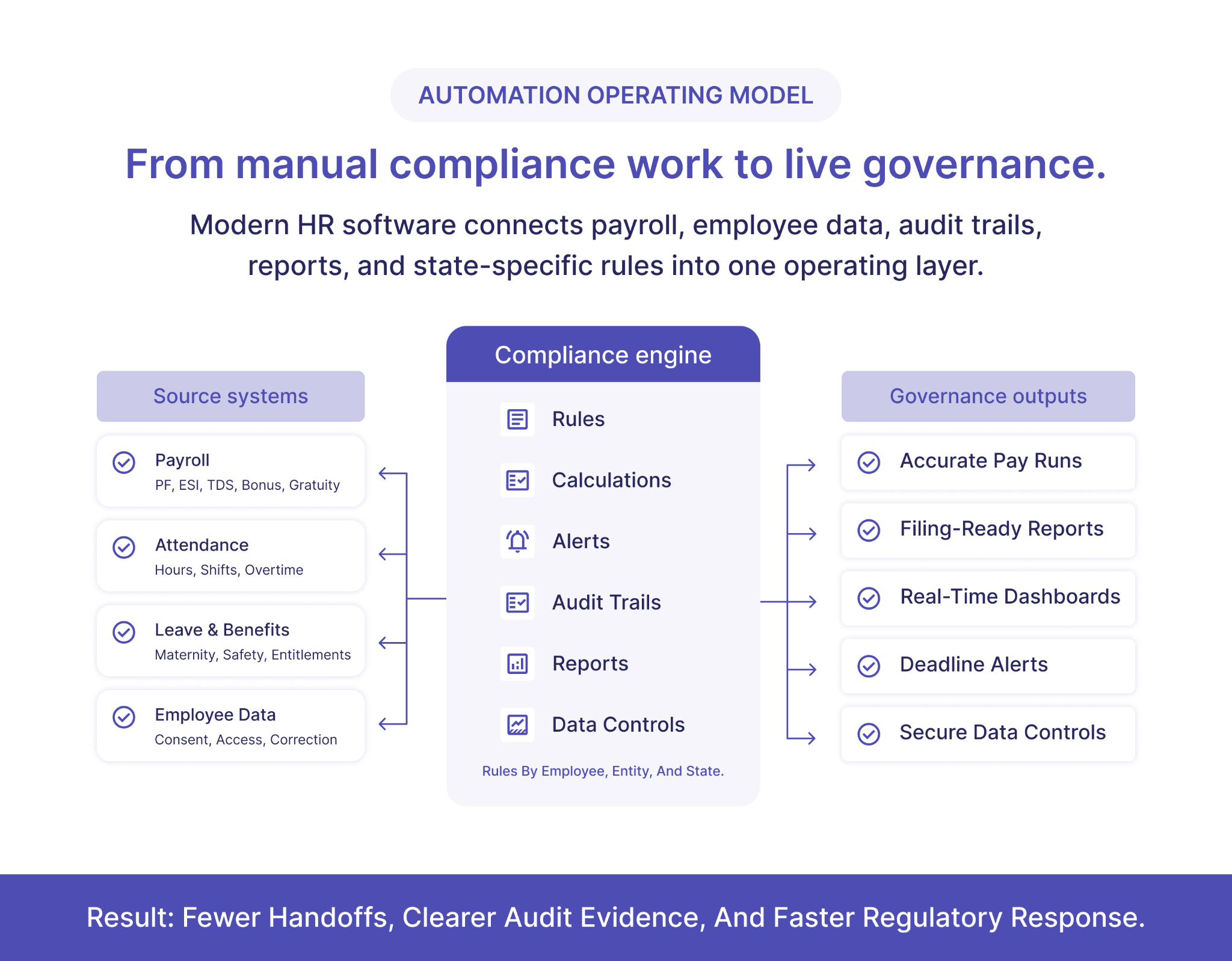
HR compliance is an evolving discipline subject to economic, financial, and political changes at the company, state, and national levels. In 2026, with the DPDP Act in full force and state-level labour law amendments accelerating, manual compliance tracking has exceeded what enterprise teams can sustain at scale.
Modern HR software automates compliance processes, reducing the risk of errors frequently occurring in manual procedures. Pair the automation with ZingHR's AI-powered HCM architecture, which delivers compliance natively on one codebase and one database.
Key ways HR software simplifies statutory compliance:
- Automated payroll processing drives on-time, accurate payments to employees based on their employment contracts, with built-in calculations for PF, ESI, TDS, bonus, and gratuity deductions.
- Secure employee data management through modern HRMS platforms provides compliant storage, processing, and access controls for confidential employee data, adhering to the Digital Personal Data Protection Act (DPDP Act), 2023.
- Performance-linked compensation via performance management modules drives fair, transparent release of bonuses and increments based on documented employee performance.
- Real-time audit trails maintained in HR systems support transparent compliance audits and enable real-time modifications when legislative changes occur.
- Automated statutory report generation reduces manual drafting errors and drives timely submission of returns and filings to government bodies.
- Multi-state compliance engines automatically apply the correct wage schedules, deduction rates, and filing deadlines based on each employee's work location, critical for enterprises operating across multiple Indian states.
Organisations running cloud-based HR software gain the additional advantage of real-time updates, centralised data governance, and scalable compliance infrastructure.
Benefits of Statutory Compliance Software
The benefits of statutory compliance software cluster into five areas: penalty avoidance, operational efficiency, regulatory adaptability, data-driven intelligence, and employer brand. Each compound at enterprise scale. Surface them through Ghrowth.ai's role-specific command centres for boardroom-grade visibility.
1. Penalty Avoidance and Risk Mitigation
The most immediate benefit of statutory compliance software is the systematic reduction of penalty exposure. Automated deadline tracking, contribution calculations, and filing reminders eliminate the human errors accounting for the majority of compliance failures. For enterprises, where a single payroll error can cascade across thousands of employees, the reduction represents material financial risk mitigation.
2. Operational Efficiency at Scale
Manual compliance management consumes significant HR bandwidth: tracking deadlines across states, calculating variable deductions, preparing statutory returns. Compliance software automates these workflows, freeing HR teams to focus on strategic initiatives such as workforce planning, talent acquisition, and employee engagement. Enterprises with 1,000+ employees typically experience the most significant efficiency gains.
3. Real-Time Regulatory Adaptability
Labour laws in India are subject to frequent amendments: minimum wage revisions, ESI threshold changes, new state notifications. Compliance software with integrated regulatory update engines applies these changes automatically, ensuring organisations are never operating on outdated rules. The capability is particularly valuable for enterprises in multiple states, where manual tracking of state-specific changes is impractical.
4. Data-Driven Compliance Intelligence
Modern compliance platforms generate dashboards and analytics providing Board-level visibility into compliance status, pending filings, contribution trends, and risk areas. The capability turns compliance from a reactive, operational function into a proactive governance capability, giving CXOs the intelligence they need for informed decision-making.
5. Employee Trust and Employer Brand
When employees consistently receive accurate, timely wages with correct deductions and benefits, trust in the employer strengthens. Statutory compliance software makes every payslip reflect accurate PF, ESI, and tax calculations, building the foundation for a strong employer brand and higher retention rates.
Key Features of Modern Statutory Compliance Software
Six capabilities separate enterprise-grade statutory compliance software from generic HR tools. Use them as a checklist when evaluating platforms against ZingHR's unified architecture, built natively on one codebase and one database.
1. Multi-Act Compliance Engine
The software should support simultaneous compliance with all major Indian labour laws: EPF Act, ESI Act, Minimum Wages Act, Payment of Wages Act, Bonus Act, Gratuity Act, Factories Act, Maternity Benefit Act, PoSH Act, and DPDP Act, within a single platform. Patchwork compliance across multiple tools creates reconciliation overhead and integration risk.
2. State-Specific Wage and Tax Configuration
Indian compliance is layered with state-specific rules. The platform should automatically apply the correct minimum wage, professional tax rate, and Shops and Establishments Act variant based on each employee's work location, without manual configuration for every entity.
3. Automated Statutory Filing and Return Generation
Filing-ready document generation (ECR, Form 24Q, ESI returns) eliminates the manual drafting consuming significant payroll bandwidth and creating filing errors. The platform should generate, validate, and submit filings within statutory deadlines.
4. Consent Management and Data Protection Controls
With the DPDP Act 2023 fully enforceable, the platform must include consent capture workflows, purpose limitation controls, data subject request handling, and breach notification capabilities for employee personal data.
5. Real-Time Compliance Dashboards and Alerts
Static monthly compliance reports leave Boards a quarter behind on regulatory exposure. Real-time dashboards showing filing status, pending deadlines, and risk exposure across every entity and location give compliance officers and Board members continuous visibility. Ghrowth.ai surfaces compliance signals on role-specific command centres for CHROs, CFOs, and CEOs.
6. Integration with Payroll, Attendance, and Leave Management
Compliance rules must apply automatically to payroll calculations, attendance tracking, and leave management. ZingZeroTAP, ZingHR's zero-touch payroll engine, applies statutory rules natively to every pay run, eliminating the manual data handoffs leading to compliance errors.
Why Enterprises Choose ZingHR for Statutory Compliance in HR
ZingHR is built for enterprises where HR cannot run on disconnected modules, local compliance patches, and manual reporting. Its AI-powered Hire-to-Rehire platform brings 35+ modules onto one codebase and one database, with 12 vertical-specific solutions and 2.8M + active users across India, MEA, and SEA.
For CXOs, the shift is practical. It is cleaner compliance control, unified workforce data, and faster HR decisions from one system.
- ZingZeroTAP, the zero-touch payroll engine: Automates PF, ESI, TDS, bonus, and gratuity calculations with built-in multi-state compliance engines. The engine handles complex multi-state and multi-country compliance without manual intervention, processing statutory deductions natively for every pay cycle.
- Ghrowth.ai, its agentic intelligence engine: Sits above compliance data to deliver role-specific command centres. CHROs see compliance posture by act, state, and entity. CFOs see the financial implications of compliance exposure. The Board sees a consolidated governance view with risk signals surfaced before they become incidents.
- AI-based personalised LMS: Delivers compliance training updates directly to HR teams and employees, ensuring organisational awareness keeps pace with legislative changes.
- Automated worker classification: Handles full-time, contractual, and gig classifications without manual rule maintenance, reducing misclassification risk in regulated sectors.
- 12 purpose-built vertical solutions: Cover BFSI, Manufacturing, Pharma, Healthcare, IT and ITeS, QSR, Retail, Hospitals, Education, Logistics, Energy, and Conglomerates, with compliance configurations tuned to each sector.
For CHROs, CFOs, and Boards of large enterprises in 2026, ZingHR transforms statutory compliance from a manual, reactive burden into a proactive, intelligent governance capability.
Make HR Compliance a Strategic Asset for the Board
HR and payroll compliance is the control layer behind a well-governed Indian enterprise. The 10 core acts, sector-specific rules, state-level variations, and DPDP Act obligations create a level of complexity that manual tracking cannot reliably handle at scale.
Unified HCM platforms with embedded compliance engines help enterprises move from penalty firefighting to governed execution. HR and finance leaders get cleaner records, earlier risk visibility, and more time to focus on workforce planning, succession, growth, and EBITDA impact.
To see how ZingHR's Hire-to-Rehire platform, ZingZeroTAP, and Ghrowth.ai turn compliance into a strategic asset, book a demo with ZingHR.
Frequently asked questions (FAQs)
HR statutory compliance demands adherence to Indian labour laws (Minimum Wages, Factories, EPF, ESI Acts) governing wages, benefits, and workplace safety. You must execute legal mandates accurately, such as remitting PF on time. Non-compliance risks ₹1,000–₹10 lakh penalties, imprisonment, and licence cancellation.
Core Indian labour laws include the EPF (12% contribution), ESI (social security), Minimum Wages, Payment of Wages, Factories (48-hour limit), Standing Orders, Maternity Benefit (26 weeks leave), and the PoSH Acts. Each framework carries specific applicability thresholds and non-compliance penalties.
Integrate consent workflows into your HRMS to automate DPDP Act 2023 compliance. HR must obtain explicit consent, secure sensitive records, and enforce purpose limitation and breach protocols. Violations risk up to ₹250 crore in penalties, making this a board-level priority.
Use an HRMS to automate payroll compliance and guarantee statutory deadlines. Your mandatory checklist must include onboarding verifications, monthly wage processing (minimum wage, PF, ESI, TDS), timely statutory deposits, annual returns, bonus calculations, gratuity, attendance tracking, and quarterly audits.
Statutory non-compliance triggers severe financial and operational risks. Penalties range from ₹50,000 (PoSH Act) to ₹250 crore (DPDP Act). Violations also cause director imprisonment, facility closures, and licence cancellations. Beyond legal fines, compliance failures destroy brand reputation and disrupt business continuity.
Deploy an HRMS with a native Indian compliance engine like ZingHR. Automated platforms calculate statutory deductions (PF, ESI, TDS), file returns, and track multi-state deadlines. Integrated attendance and consent modules guarantee Factories Act and DPDP Act compliance while delivering board-level oversight.
What to do next?
See ZingHR in Action
Join the 1,200+ enterprises that have replaced fragmented HR with one intelligent, future-ready platform. See ZingHR in 30 minutes.
Build the Organization You Want
Great HR drives retention, capability, and culture. ZingHR takes care of the operational layer so your people team owns the strategy.

Elevating Impact.
Defining Destiny
See how ZingHR's AI-powered Hire-to-ReHire platform frees your CPO to lead with purpose and deliver the outcomes your Board is watching for


ZingHR is the AI-powered Hire-to-ReHire platform built for one purpose to remove every transactional layer of HR from your organisation, permanently.