Employee Attrition Rate: Calculation, Strategies, and Benchmarks
A 10% annual attrition rate concentrated in compliance-critical roles carries a very different strategic weight than the same rate spread evenly across the organisation. Here is how to tell the difference.
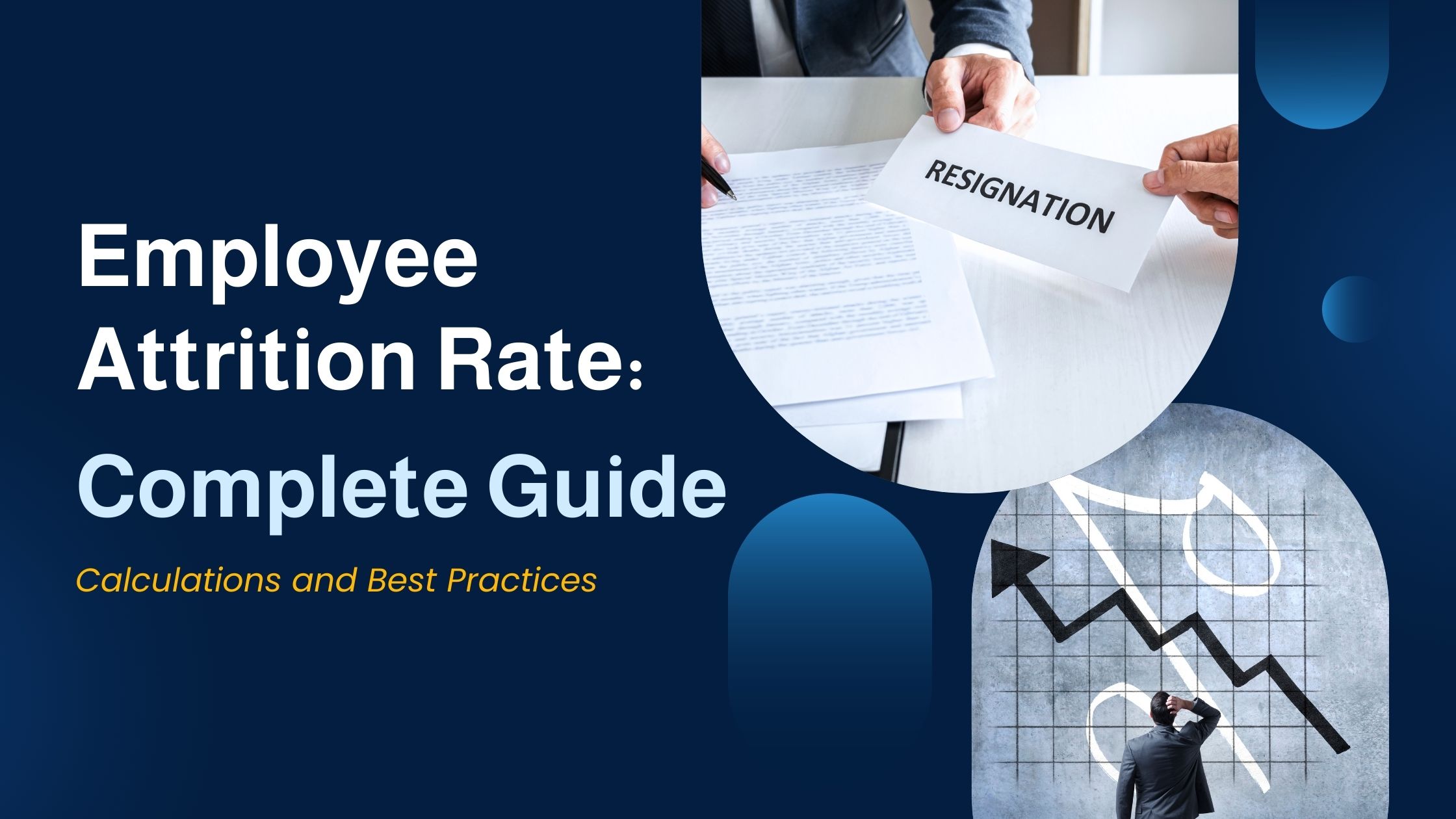
Table of contents
One unstitched HR platform to manage your entire workforce, from Hire to Re-Hire.
Talent Management solutions built for growing and exceptional people
Built-in compliance tools that update with changing regulations
Automated payroll, attendance, and leave management
Insights that help HR leaders make faster, better decisions

Key Takeaways
- Employee attrition rate measures the percentage of employees leaving an organisation during a specific period and not replaced, reflecting permanent workforce reduction.
- Standard formula: (Number of employees who left and were not replaced ÷ Average number of employees) × 100.
- Healthy benchmark: Around 10% or less annual attrition is considered healthy for most stable organisations. Rates above 20% typically signal retention problems.
- Attrition is different from turnover: Turnover includes replaced departures, while attrition specifically tracks unreplaced losses, shrinking headcount.
- Enterprise organisations in BFSI, pharma, manufacturing, and IT benefit most from segmented attrition analytics by department, tenure, demographics, and geography.
- ZingHR's AI-powered Hire-to-Rehire platform, powered by Ghrowth.ai, its agentic intelligence engine, surfaces real-time attrition insights for CHROs and CXOs across 35+ modules on one codebase and one database. Book a demo to see flight-risk modelling in action.
“Measurement is one thing, what you measure is another. You can measure a lot of things that have nothing to do with performance and that don't help a company implement a system that allows managers to create change. ”
says Jim Harter, Gallup’s chief scientist of employee engagement and well-being.
For CHROs, CFOs, and HR leaders at enterprise scale, a rising employee attrition rate is more than a people problem. The metric is a strategic risk affecting board-level outcomes, operational continuity, and long-term competitiveness.
Every unreplaced departure compounds workload on remaining staff, erodes institutional knowledge, and inflates rehiring costs, rippling across quarterly budgets. TruePlan Advisors' 2025 retention research reported an EY survey finding 38% of employees are likely to leave their jobs; attrition analytics must inform executive decisions as much as HR dashboards.
The challenge intensifies across regulated industries like BFSI, pharma, and manufacturing, where compliance obligations and specialised skill requirements make every departure more costly to absorb.
The guide ahead provides a complete, enterprise-focused reference on employee attrition rate: what it means in HR, how to calculate it accurately (with worked examples), how it differs from turnover and retention rates, and the current industry benchmarks.
What Is Employee Attrition Rate?
Employee attrition rate is the percentage of employees leaving an organisation during a specific period, through resignation, retirement, layoff, or position elimination, whose roles are not subsequently filled.
The metric is a core workforce indicator HR teams use to quantify long-term talent loss and permanent headcount reduction. Where general turnover counts every departure as long as the seat eventually fills, attrition reflects a net shrinkage of the workforce. Use ZingHR's talent management capabilities to segment attrition by department, tenure, and demographic for targeted intervention.
In HR practice, attrition rate serves as both a diagnostic and predictive metric. A consistently high attrition rate signals potential issues with job satisfaction, career development, compensation competitiveness, or organisational culture. For enterprise organisations operating across multiple locations and regulatory environments, tracking attrition at the department, tenure band, and demographic level is essential for targeted workforce planning.
1. Attrition Rate Meaning in HR
In HR, attrition rate functions as a workforce health indicator. The metric moves beyond simple headcount tracking to surface patterns demanding executive attention: which departments lose the most people, at what tenure stage employees leave, and which demographic segments are most at risk.
A high attrition rate could indicate underlying issues like inadequate compensation, limited growth opportunities, or cultural misalignment, all areas where HR teams need to review and strengthen their engagement strategies.
2. Types of Employee Attrition
Understanding the different types of attrition helps HR leaders diagnose problems accurately and allocate retention resources where they matter most:
- Voluntary attrition: Employees choose to leave for a new role, career change, relocation, or personal reasons. The type is most directly addressable through improved engagement, compensation, and culture.
- Involuntary attrition: The organisation initiates the separation through layoffs, restructuring, or termination for cause. While often driven by business strategy, high involuntary attrition can damage employer brand and survivor morale.
- Natural attrition: Departures through retirement, contract expiry, or health-related exits. These are largely predictable and should be factored into succession planning.
- Demographic-specific attrition: Disproportionate departures from a particular age group, gender, ethnicity, or location segment. Tracking the variant is critical for diversity, equity, and inclusion (DEI) initiatives.
- Early attrition (first 90 days): New hires leave within their initial probation period. A high early attrition rate often points to onboarding failures or role-expectation misalignment.
How to Calculate Employee Attrition Rate
Calculating employee attrition rate requires two data points: the number of employees who left and were not replaced during a period, and the average number of employees during the same period. For multi-entity enterprises, the calculation needs to roll up cleanly from each business unit, which is where unified HCM architecture earns its place.
1. The Employee Attrition Rate Formula
Where:
Worked Example 1: Annual Calculation
An organisation has 120 employees at the start of the year and 110 by year-end. 10 employees left, and none were replaced.
- Average workforce: (120 + 110) ÷ 2 = 115.
- Attrition rate: (10 ÷ 115) × 100 = 8.7%.
An 8.7% annual attrition rate falls within the healthy range for most industries, suggesting a manageable workforce reduction.
Worked Example 2: Larger Enterprise
A manufacturing company with 1,200 employees at the start of the year ends with 1,080. 120 employees left without replacement.
- Average workforce: (1,200 + 1,080) ÷ 2 = 1,140.
- Attrition rate: (120 ÷ 1,140) × 100 = 10.5%.
At 10.5%, the rate sits at the upper boundary of what many HR experts consider healthy, warranting a closer look at departmental breakdowns.
Worked Example 3: Monthly Attrition
A retail chain has 500 employees at the start of March and 485 at the end of the month. 15 employees left.
- Average workforce: (500 + 485) ÷ 2 = 492.5.
- Monthly attrition rate: (15 ÷ 492.5) × 100 = 3.05%.
Monthly attrition rates are useful for spotting seasonal spikes or the impact of specific events. To annualise, multiply by 12 (approximation) or aggregate actual monthly data.
2. How to Calculate Early Attrition Rate (First 90 Days)
The early attrition rate focuses on employees leaving within a defined early tenure window. To calculate it, divide the number of employees who left within their first 90 days by the total number of new hires in the period and multiply by 100.
For instance, if 15 out of 60 new hires left within 90 days, early attrition is (15 ÷ 60) × 100 = 25%.
A high early attrition rate typically signals issues with onboarding, role clarity, or hiring-process alignment.
What Is a Good Employee Attrition Rate?
A good employee attrition rate depends on industry, company size, and organisational objectives, but many HR experts view 10% or less annual attrition as healthy for stable organisations.
Rates above 20% generally signal retention problems demanding immediate attention. With 1 in 5 employees leaving every year, operational disruption, recruitment costs, and morale erosion compound quickly.
For sector context, ZingHR's vertical solutions align attrition benchmarks with industry-specific compliance and workforce realities.
Typical annual attrition rate ranges by enterprise industry, 2026.
Gallup's 2024 Employee Retention and Attraction research found 52% of U.S. employees are actively watching for or seeking a new job, the highest self-reported turnover risk Gallup has measured since 2015.
The same research showed 42% of employees who voluntarily left their organisation in the past year report their manager or organisation could have done something to prevent the departure, reframing attrition from an inevitability into a measurable governance problem.
Interpreting your rate requires context. A 10% attrition rate means, on average, 10 out of every 100 employees left the organisation during the period and their positions were not filled. For enterprise organisations, the number must be read in context.
When attrition concentrates in mission-critical roles or high-performing segments, even a seemingly moderate rate can have an outsized strategic impact.
Benchmarks and statistics are sourced from named reports with publication dates, and all formulas reflect standard HR analytics methodology. The goal is to provide enterprise HR leaders with an accurate, balanced, and actionable reference.
Industry Attrition Rates 2026: Insights and Trends
Attrition rates vary significantly across industries, and the 2026 landscape reflects a labour market shaped by shifting employee expectations, automation, and evolving work models. Below are the key trends enterprise HR leaders should monitor, with sector-specific vertical solutions providing the underlying workforce data.
1. Tech & IT Industry
The tech sector continues to experience higher attrition, with many organisations reporting annual rates between 13% and 20%. Fierce competition for specialised talent, particularly in AI, cybersecurity, and cloud engineering, gives employees significant bargaining power.
For IT-heavy enterprises, real-time attrition dashboards powered by cloud HRMS architecture allow detection and response to departmental flight risks before they cascade.
2. Healthcare & Pharma Industry
Post-pandemic burnout remains a persistent driver in healthcare and pharma, where attrition rates commonly range from 15% to 20%. Staff in clinical and frontline roles frequently cite workload intensity and limited career mobility as primary reasons for leaving.
Organisations using ZingHR's pharma and healthcare solutions for workforce analytics gain earlier visibility into at-risk populations.
3. BFSI (Banking, Financial Services & Insurance)
The BFSI sector typically maintains tighter attrition at 10–12%, driven by regulatory stability and structured career paths. However, fintech disruption and remote-work expectations are reshaping employee priorities.
Enterprise banking groups using BFSI-specific HCM modules can track attrition across branch networks, compliance-critical roles, and customer-facing teams in a single view.
4. Retail & Hospitality
Retail and hospitality remain high-attrition environments, often exceeding 60% annually when seasonal and part-time roles are included.
The pattern is largely structural. The nature of shift-based, hourly work drives higher voluntary departure rates.
5. Manufacturing
Manufacturing attrition typically falls between 10% and 15%, though skilled-trades shortages in areas like welding, CNC machining, and quality assurance create pockets of significantly higher departure rates.
Multi-plant operations benefit from centralised workforce management tools surfacing site-level attrition patterns and enabling proactive workforce rebalancing.
6. Higher Education
CUPA-HR's September 2025 employee retention survey found that one-fourth of higher education employees reported they were likely or very likely to look for other employment in the next year.
Departments most at risk include research and sponsored programmes (28%), academic affairs (27%), and student affairs (26%).
Attrition Rate vs Turnover Rate
Employee attrition and employee turnover are related but distinct metrics serving different analytical purposes. Confusing the two distorts retention strategy and undermines board-level workforce reporting. Use ZingHR's analytics layer to track both separately and surface the divergence.
- Attrition rate measures employees leaving and whose positions are not replaced, reflecting a net reduction in headcount. Attrition cannot exceed 100%.
- Turnover rate tracks all departures, including replaced ones. Turnover can theoretically exceed 100% in high-churn environments (e.g., a single role filled and vacated multiple times in a year).
Attrition rate vs turnover rate by replacement status, indicator, and theoretical maximum.
Worked example: 15 employees left in a year, and the average headcount was 200, so the turnover rate is (15 ÷ 200) × 100 = 7.5%.
The distinction matters for strategic planning. High attrition during downsizing requires a focus on organisational stability and survivor engagement. High turnover with active rehiring points to issues with job satisfaction, compensation, or management quality.
Attrition Rate vs Retention Rate
Retention rate is the inverse of attrition. The metric measures how many employees stay with the organisation over a given period. Tracking both, alongside ZingHR's engagement analytics, gives a fuller view of workforce health than either metric alone.
Worked example: a company starts the year with 150 employees and ends with 130, so the retention rate is (130 ÷ 150) × 100 = 86.7%.
A high retention rate with moderate attrition concentrated in low-performing segments may actually be healthy. Conversely, a high retention rate masking stagnation in leadership roles can create succession-planning risks. The two metrics together provide a complete workforce picture.
Attrition Rate vs Churn Rate
Churn rate is a customer-facing metric. The metric measures the percentage of customers who stop using a product or service over a period. Employee attrition rate measures the percentage of employees leaving and not being replaced.
Despite occasional conflation in casual HR conversations, these are fundamentally different metrics tracking different stakeholder groups. Use unified analytics to track both customer and employee health on connected dashboards.
The two metrics together signal organisational stability. High customer churn affects revenue, while high employee attrition affects operational capacity and institutional knowledge. Enterprise leaders should monitor both through integrated analytics platforms.
Causes of High Employee Attrition (and Solutions)
Understanding why employees leave is the prerequisite to retaining them. Below are the most common and addressable causes of high attrition, paired with actionable solutions. ZingHR's HR Launchpad provides the underlying data to diagnose each one.
1. Lack of Career Development
Employees seeing no clear path to advancement within the organisation will eventually seek it elsewhere. When high performers spend years in the same role without promotion, mentorship, or skill-building opportunities, stagnation erodes both engagement and loyalty.
Solution: Establish transparent career progression frameworks. Provide regular performance feedback, invest in upskilling programmes, and promote from within wherever possible.
Organisations using structured talent management can map individual career trajectories to organisational needs, making growth visible and measurable.
2. Uncompetitive Compensation
When salaries fall below market benchmarks, even the most engaged employees become vulnerable to external offers. Compensation dissatisfaction is frequently cited in exit interviews across every industry.
Solution: Conduct regular salary benchmarking against industry standards and geographic norms. Proactively adjust compensation before employees feel compelled to negotiate externally.
Supplement base pay with comprehensive benefits: health insurance, retirement plans, wellness programmes, and equity or bonus structures tied to performance.
3. Work-Life Imbalance
Persistent overwork, unrealistic deadlines, and inflexible schedules drive burnout, pushing employees out. The pattern is especially acute in healthcare, consulting, and technology roles where always-on expectations are normalised.
Solution: Set realistic workload expectations. Offer flexible working hours, hybrid and remote options, and enforce boundaries around after-hours communication.
Enterprise HR platforms with real-time workload analytics can flag teams at burnout risk before attrition spikes.
4. Toxic Work Environment and Poor Leadership
The iHire data confirms that toxic culture and poor leadership are among the top three attrition drivers in 2026. When employees feel psychologically unsafe, undervalued, or micromanaged, no amount of compensation can retain them long term.
Solution: Invest in leadership development. Conduct regular employee pulse surveys and 360-degree feedback cycles. Act visibly on feedback to demonstrate employee input shapes organisational decisions.
A unified HR platform centralises engagement data, making it easier to identify and address leadership-related attrition patterns across business units.
5. Inadequate Onboarding
A weak first impression during onboarding creates early attrition. New hires leaving within 90 days represent wasted recruitment investment and team disruption. When new employees feel disconnected from company culture, unclear about expectations, or unsupported in their first weeks, they leave quickly.
Solution: Design structured onboarding programmes extending beyond Day 1 paperwork. Include buddy systems, 30/60/90-day check-ins, role-specific training, and cultural immersion.
Track early attrition separately and treat it as a leading indicator of onboarding effectiveness.

7 Strategies to Reduce Employee Attrition
Reducing attrition is a systemic, ongoing effort spanning culture, compensation, analytics, and leadership. The following seven strategies reflect what enterprise HR leaders in 2026 are prioritising to move the needle on retention.
Each can be operationalised through ZingHR's Hire-to-Rehire platform.
1. Strengthen Employee Engagement
Engagement is the strongest predictor of voluntary retention. Employees feeling involved, trusted, and connected to organisational purpose are significantly less likely to leave.
Implement regular pulse surveys, one-on-one meetings between managers and team members, town halls, and structured engagement programmes linking individual contributions to company-wide goals. Act on survey results visibly. Employees disengage fastest when feedback disappears into a void.
2. Offer Competitive Compensation and Benefits
Fair compensation remains foundational. Analyse market data, review salary benchmarks at least annually, and close pay gaps proactively. Layer in meaningful benefits: comprehensive health coverage, retirement matching, mental health support, learning stipends, and flexible leave policies.
Compensation should be transparent and internally equitable. Perceived unfairness between peers with similar roles is a potent attrition trigger.
3. Build Succession Planning into Culture
Succession planning signals long-term commitment to employees. When individuals see the organisation investing in their growth and preparing them for leadership, they perceive a future worth staying for. Identify high-potential employees early, create development plans, and communicate career timelines openly.
4. Redesign the Onboarding Experience
First impressions are retention decisions. A strong onboarding programme reduces early attrition, accelerates time-to-productivity, and builds cultural integration from Day 1.
Include role clarity sessions, team introductions, mentor assignments, and structured milestones at 30, 60, and 90 days. Track early attrition separately to measure onboarding effectiveness.
5. Analyse Attrition Data Systematically
You cannot address attrition without understanding its patterns. Segment attrition data by department, tenure, role level, demographics, and geography to pinpoint exactly where attrition is concentrated, whether that's a specific business unit, location, team size, or tenure band. High-concentration zones signal systemic issues that require targeted intervention rather than organisation-wide fixes.
Conduct thorough exit interviews, asking departing employees what they liked, what drove them out, and what would have made them stay.
Use these insights to identify systemic issues versus isolated events. Enterprise analytics platforms consolidate the data across business units, replacing fragmented spreadsheets with a single source of truth.
6. Monitor Turnover Data Separately
Turnover data (including replaced departures) reveals different dynamics than attrition alone. Are employees leaving within two years? Are they leaving for better pay, better roles, or better cultures?
Distinguishing voluntary from involuntary turnover, and early from mid-tenure departures, allows HR teams to design targeted interventions rather than broad, unfocused retention programmes.
7. Build a Positive, Inclusive Work Culture
Culture is the retention lever no compensation package can fully replace. A critical and often underweighted dimension of culture is manager experience, the quality of the relationship employees have with their direct managers. Research consistently shows that people leave managers, not companies. Manager behaviours such as recognition frequency, feedback quality, workload fairness, and psychological safety directly shape an employee's decision to stay or leave.
Create a work environment where employees feel psychologically safe, valued, and seen. Celebrate achievements, maintain transparent communication, foster inclusion across all levels, and hold leaders accountable for team health metrics.
Culture is a measurable attrition driver with hard-dollar consequences and a permanent line item on HR's strategic agenda.
Benefits of Tracking Employee Attrition Rate
Tracking attrition systematically delivers compounding benefits across workforce planning, risk detection, cost containment, compliance, and board-level credibility. The benefits cluster into five areas, each surfaced cleanly through Ghrowth.ai's role-specific command centres.
1. Informed Workforce Planning
Attrition data is the foundation of accurate headcount forecasting. When HR leaders know historical attrition rates by department and role level, they can anticipate future vacancies, align recruitment pipelines, and budget for talent acquisition with precision.
For multi-location enterprises, the precision prevents over-staffing in some regions while under-staffing in others.
2. Earlier Risk Detection
Tracking attrition monthly and quarterly, rather than only annually, reveals trends and anomalies that annual reviews miss. A sudden spike in attrition within a specific team, location, or tenure cohort is an early warning signal letting HR intervene before the problem compounds.
3. Cost Containment
Every unreplaced departure eliminates a salary line item, but the hidden costs of knowledge loss, team disruption, and overtime absorption often exceed short-term savings. By tracking attrition alongside productivity and engagement metrics, enterprise CFOs can quantify the true cost of workforce shrinkage and make data-driven decisions about when to invest in retention versus when to accept natural attrition.
4. Regulatory and Compliance Alignment
In regulated industries (BFSI, pharma, healthcare, manufacturing), attrition in compliance-critical roles creates audit risk and operational vulnerability.
Tracking attrition by role type ensures departures in regulatory, quality, or safety functions are flagged immediately, triggering expedited replacement or knowledge-transfer protocols.
5. Board-Level Reporting and Strategic Credibility
Attrition rate is one of the HR metrics boards and investors care about. Presenting accurate, segmented attrition data with trend lines and benchmarks demonstrates strategic HR leadership and positions the CHRO as a business partner with quantifiable workforce intelligence.
Key Features of Modern Attrition Analytics Software
When evaluating HR platforms for attrition management, enterprise organisations should prioritise capabilities going beyond dashboards. The features below separate strategic workforce intelligence from retrospective reporting.
Pair feature evaluation with a review of ZingHR's AI-powered HCM architecture, built natively on one codebase and one database.
1. Real-Time Attrition Dashboards
Static quarterly reports fall short for organisations with dynamic workforces. Modern platforms provide live dashboards displaying attrition rates by department, location, tenure band, and demographic segment, updated as departures are processed.
The cadence lets HR leaders detect and respond to attrition trends as they develop, weeks or months ahead of where quarterly cycles would surface the same signal.
2. Predictive Flight-Risk Modelling
Advanced analytics and machine learning algorithms identify employees at higher risk of departure based on patterns like engagement survey responses, performance trajectory, tenure, compensation history, and manager feedback.
Predictive models allow HR to intervene proactively by adjusting workloads, initiating retention conversations, or accelerating promotions before the resignation is submitted. Ghrowth.ai, ZingHR's agentic intelligence engine, surfaces flight risks as part of the CHRO command centre.
3. Integrated Exit Interview Analytics
Exit interviews generate qualitative data, often rich but poorly utilised. Modern platforms digitise exit surveys, tag responses by theme (compensation, culture, leadership, growth), and aggregate insights across the organisation to surface systemic issues.
The integration turns anecdotal feedback into actionable, pattern-based intelligence.
4. Multi-Entity and Multi-Geography Support
Enterprise organisations operating across countries, regulatory environments, and business units need attrition analytics aggregating across entities. Workforce management tools supporting multi-entity consolidation eliminate data silos and let CHROs compare attrition patterns across geographies from a single command centre.
5. Segmented Reporting by Demographics and Tenure
Demographic-specific attrition (by age, gender, ethnicity, or family role) is essential for DEI accountability and targeted intervention design. Similarly, tenure-band analysis distinguishes early attrition (first 90 days) from mid-career and late-career departures, each requiring a different retention approach.
6. Compliance-Aware Workforce Analytics
In industries governed by strict regulatory requirements (BFSI, pharma, manufacturing), attrition in compliance-critical roles poses audit risk. Attrition analytics platforms should flag departures in regulated positions, trigger knowledge-transfer workflows, and generate audit-ready reports demonstrating workforce continuity.
Why Enterprises Choose ZingHR for Attrition Analytics
ZingHR delivers a unified, AI-powered Hire-to-Rehire platform designed for enterprise-scale complexity. The platform's 35+ modules sit on one codebase and one database, eliminating the data fragmentation defining stitched-together HCM suites built from acquisitions.
Attrition data consolidates across departments, geographies, and business units into a single source of truth, giving CHROs and CXOs actionable, board-level insights.
- Ghrowth.ai, its agentic intelligence engine: Sits above attrition data to deliver role-specific command centres for boards and CXOs. The CHRO views workforce composition, flight risks, and compliance posture. The CFO's view connects attrition trends to headcount cost and budget variance. The CEO's view consolidates execution and accountability lines. All flow from the same data layer, with no manual reconciliation.
- AI agents across the employee lifecycle: Handle exit interview tagging, flight-risk scoring, and anomaly detection in the background, freeing your HR team's attention for strategic retention work.
- ZingZeroTAP, the zero-touch payroll engine: Anchors the same architecture for payroll, ensuring attrition-driven payroll changes (final settlements, gratuity, leave encashment) process without manual intervention.
- 12 purpose-built vertical solutions: Cover BFSI, manufacturing, pharma, retail, IT and ITes, healthcare, hospitals, logistics, and conglomerates, with attrition models tuned to sector-specific role taxonomies and shift patterns.
Over 1,200 enterprises across 12 industries, including BFSI, manufacturing, pharma, retail, and IT, trust ZingHR to move attrition analytics from reactive spreadsheets to proactive workforce intelligence.
With 2.8 million active users and 12 purpose-built vertical solutions, the platform's attrition capabilities are tested at scale across India, MEA, and SEA.
One of ZingHR's enterprise customers, a leading airport services company in India, captured the operational dividend of moving to a consistent HCM platform: improved process discipline across high-volume, shift-based workforces where attrition concentration in operational roles directly affects service continuity.
The same architectural principles apply across regulated, multi-entity environments where attrition signals must surface in real time, before they materialise at quarter-end as a board-level concern.
For enterprise HR teams managing workforces of 1,000 to 100,000+ across regulated environments, ZingHR replaces operational complexity with clarity. Your people team owns the strategy, and the platform handles the execution.
Turn Attrition Data into Retention Strategy
Employee attrition rate is a core HR metric revealing how quickly your workforce is shrinking due to unreplaced departures. The standard formula (number of leavers divided by average headcount, multiplied by 100) is straightforward, but the strategic value lies in how consistently and granularly you track it over time.
Interpreting your attrition rate requires context. Around 10% annual attrition is widely considered healthy for stable organisations, while rates materially above the threshold, especially when concentrated in high-impact roles, signal deeper issues in culture, engagement, compensation, or leadership.
For enterprise organisations in 2026, the imperative is clear. Move beyond aggregate annual calculations. Monitor attrition by segment (voluntary versus involuntary, department, tenure band, demographics, and geography) to design targeted retention strategies and workforce plans protecting institutional knowledge, maintaining compliance, and sustaining operational continuity.
With the right analytics platform and a commitment to acting on what the data reveals, reducing attrition becomes an operational discipline with measurable quarterly outcomes.
To see how ZingHR's Hire-to-Rehire platform and Ghrowth.ai turn attrition data into a retention strategy, book a demo with ZingHR.
Frequently asked questions (FAQs)
Employee attrition rate is the percentage of employees leaving an organisation over a specific period and not being replaced. HR teams typically calculate it annually to understand long-term workforce reduction and talent loss. The metric is distinct from turnover, where roles are refilled. The formula: (Number of employees who left and were not replaced ÷ Average number of employees) × 100.
To calculate the employee attrition rate, divide the number of employees who left and were not replaced during a period by the average number of employees in the same period, then multiply by 100. The average number of employees equals (employees at start of period + employees at end of period) ÷ 2. For example, if 20 employees left and your average headcount was 200, your attrition rate is (20 ÷ 200) × 100 = 10%.
A good employee attrition rate depends on your industry, but many HR experts consider around 10% or less annual attrition as healthy for stable organisations. In high-churn sectors like retail or hospitality, average attrition is significantly higher due to the structural nature of the work. Benchmark your rate against sector-specific data rather than relying on a single universal threshold.
Attrition rate measures employees leaving and whose positions are not replaced, indicating a net reduction in headcount. Turnover rate tracks all departures, including those where the organisation hires replacements. As a result, turnover can exceed 100% in high-churn environments, while attrition cannot.
Early attrition rate focuses on employees leaving within a defined early tenure window, such as the first 90 days. Divide the number of employees who left within their first 90 days by the total number of new hires in the period and multiply by 100. For example, if 15 out of 60 new hires left within 90 days, early attrition is (15 ÷ 60) × 100 = 25%.
A 10% attrition rate means, on average, 10 out of every 100 employees left the organisation during the period and their positions were not filled. For an organisation with 500 employees, the rate implies approximately 50 unreplaced departures per year. Whether the figure is concerning depends on where attrition is concentrated.
What to do next?
See ZingHR in Action
Join the 1,200+ enterprises that have replaced fragmented HR with one intelligent, future-ready platform. See ZingHR in 30 minutes.
Build the Organization You Want
Great HR drives retention, capability, and culture. ZingHR takes care of the operational layer so your people team owns the strategy.

Elevating Impact.
Defining Destiny
See how ZingHR's AI-powered Hire-to-ReHire platform frees your CPO to lead with purpose and deliver the outcomes your Board is watching for


ZingHR is the AI-powered Hire-to-ReHire platform built for one purpose to remove every transactional layer of HR from your organisation, permanently.